

Serum Vitamin E, Sphingolipid Genes and Interleukin Variants in MS
Three studies of multiple sclerosis (MS) published this year drew blood and asked what in it keeps step with the disease. One compares patients who take a daily B-vitamin tablet with patients who do not, and reads the lipids and the genes of a lipid signalling pathway out of the same samples. One measures a single antioxidant vitamin in the serum of 184 patients and sets it against cognition, disability and mood. One genotypes two variants in two interleukin genes and asks whether either marks who develops MS and who progresses to the harder form. The measurements are a tablet, a vitamin and two letters of DNA, and in each study the answer covers part of what was put in front of it.
Fifty-Three Patients and a Daily Tablet
Mehana and colleagues worked at the Kasr Al-Ainy MS Research Unit of Cairo University Hospitals with 53 patients diagnosed by the 2017 criteria. Twenty-five had been prescribed a daily tablet of 40 mg benfotiamine, 60 mg pyridoxine and 250 µg cyanocobalamin for at least three months; 28 had not. Pregnancy, recent infection or inflammation, familial hypercholesterolaemia, lipid-lowering drugs and steroids within the previous month were grounds for exclusion, as was any sphingosine-1-phosphate receptor modulator such as fingolimod, whose action falls on the pathway under study. From the buffy coat they measured expression of APOA1, APOA1-AS, SPHK1, SPHK2, S1PR1 and LISPR1; from plasma, ApoA1, sphingosine-1-phosphate and S1PR1 protein, along with the standard lipid panel. Expression was normalised to GAPDH and reported as fold change, and the study had been powered in advance for 26 patients per group.
What Separated the Two Groups
Every measurement separated them. Patients on the tablet had lower triglycerides, total cholesterol and LDL cholesterol and higher HDL cholesterol, higher APOA1 expression and plasma ApoA1, lower APOA1-AS, lower SPHK1 and SPHK2, less circulating sphingosine-1-phosphate, and lower S1PR1 and LISPR1. After false discovery rate correction the strongest correlations ran between the two long non-coding RNAs and the lipid they flank: APOA1-AS with sphingosine-1-phosphate at 0.75, LISPR1 with it at 0.72, the two with each other at 0.64, and HDL falling as disability rose at −0.39. The groups were not matched on everything. Comorbidity was reported by 48% of the supplemented patients and 21.4% of the others, black holes appeared on MRI in 4% against 25%, and 72% of the supplemented group fell in the three-to-nine lesion band against 25%, while half the unsupplemented group had fewer than three lesions and none of the supplemented group did. The authors call the design observational, note that the tablet was assigned by the treating physician rather than by chance, and add that adherence was self-reported and circulating vitamin levels were never measured.
Alpha-Tocopherol in 184 Italian Patients
Bruno and colleagues drew on patients followed at the Institute for Biomedical Research and Innovation of the Italian National Research Council in Mangone, in the province of Cosenza. The sample was 184 Italian patients, 63% women, mean age 36.7 years, of whom 70.7% had relapsing-remitting disease, 13.0% primary progressive, 10.9% a clinically isolated syndrome and 5.4% secondary progressive; mean age at onset was 29.1, mean duration 8.7 years, mean score on the Mini-Mental State Examination 26.9, mean disability 1.8 and mean depression score 6.2. Ninety-four healthy people served as the comparison. Serum alpha-tocopherol was measured by chromatography, and four nested regression models were fitted for each outcome, the last adding thyroid disease, hypertension, smoking, alcohol and body mass index. Sixteen point eight per cent smoked, mean body mass index was 25.1, and nobody in the sample had diabetes or raised cholesterol. The patients had first been diagnosed on the older Poser criteria, and all were confirmed against the 2017 revision on clinical and imaging review.
Cognition and Disability, but Not Mood
Patients carried less vitamin E than controls, 24.20 against 28.80 µmol/L, and the odds of carrying a diagnosis fell by 7% for each unit of it, with the curve separating cases from controls at 0.652 unadjusted and 0.679 adjusted. A unit of vitamin E was worth 0.065 points of the cognitive score, which held in the three adjusted models but not in the unadjusted one once the threshold was corrected for four outcomes. Below the cognitive cut-off of 24, patients carried 21.3 µmol/L against 24.6. Disability behaved the same way: at or above a score of 6 patients carried 20.3 µmol/L against 24.7, and ten units of vitamin E more than halved the odds of reaching it. Depression gave nothing, in any of the four models and on either side of its cut-off.
Two Variants in Two Interleukin Genes
Bakr and colleagues genotyped 131 Egyptian patients at the MS unit of Zagazig University, 82 women and 49 men, 99 with relapsing-remitting and 32 with progressive disease, against 140 unrelated controls matched for age and sex at mean ages of 32.4 and 32.1 years. Chronic inflammatory disease, another autoimmune disorder, kidney or liver disease, pregnancy and psychiatric illness were grounds for exclusion. The two variants were IL18 −137 G/C, read by allele-specific amplification, and IL21 −1472 G/T, read by cutting the amplified fragment with a restriction enzyme. Disability was scored on the standard scale and severity on the score that sets disability against disease duration. The controls came from the same geographic area, were free of neurological and autoimmune disease, and had no family history of MS. Genotype frequencies were checked against Hardy-Weinberg equilibrium, and odds ratios came from univariate logistic regression at a threshold of 0.05.
One Variant Marked Risk, the Other Did Not
The IL18 heterozygote accounted for 70.2% of patients and 49.3% of controls, the common homozygote for 24.4% against 42.8%, and the odds of MS for a heterozygote came to 2.5. The C allele reached 40.5% against 35.5%, at the edge of significance. Between the two forms of the disease the C allele ran 51.6% in progressive against 36.9% in relapsing-remitting patients, and heterozygotes carried longer disease, higher disability and higher severity, while the rare homozygotes had started later. In regression the variant and the age at onset predicted disability. IL21 gave nothing between patients and controls; it separated the two disease forms, where the rare homozygote and its allele were less common in progressive patients, and nothing against disability or severity. The authors ask for replication in larger samples and other populations. Between them the three studies drew blood from 368 people with MS and 234 controls and measured in it four lipid fractions, six transcripts, three circulating molecules, one vitamin and two single-nucleotide variants.
Disclaimer: This blog post is based on the cited studies and is intended for informational purposes only. It is not intended to provide medical advice. Please consult with a healthcare professional for any health concerns.
References:
Mehana, N. A., Ghaiad, H. R., Nooh, M. M., Amer, M. A., El-Ghoneimy, L. T., & Safwat, M. H. (2026). Association of vitamin B1/B6/B12 supplementation with sphingosine-1-phosphate signaling and its receptors in multiple sclerosis patients: relevance to LISPR1 and APOA1-AS. Bioscience Reports, 46(6), BSR20260065. https://doi.org/10.1042/BSR20260065
Bruno, F., Spadafora, P., Cuconati, M. L., Qualtieri, A., Veltri, I., De Benedittis, S., Greco, B. M., Cerantonio, A., Citrigno, L., Di Palma, G., Gallo, O., Montesanto, A., & Cavalcanti, F. (2026). Serum vitamin E levels in multiple sclerosis: association with diagnosis, cognitive function, disability, and depressive symptoms. Molecular Neurobiology, 63(1), 597. https://doi.org/10.1007/s12035-026-05878-w
Bakr, N. M., Hashim, N. A., El-Eshmawy, M. A., & El-Baz, H. A. (2026). Impact of genetic polymorphisms in the interleukin-18 and interleukin-21 genes on the risk and clinical outcomes of multiple sclerosis. BMC Neurology, 26(1), 355. https://doi.org/10.1186/s12883-026-04869-7
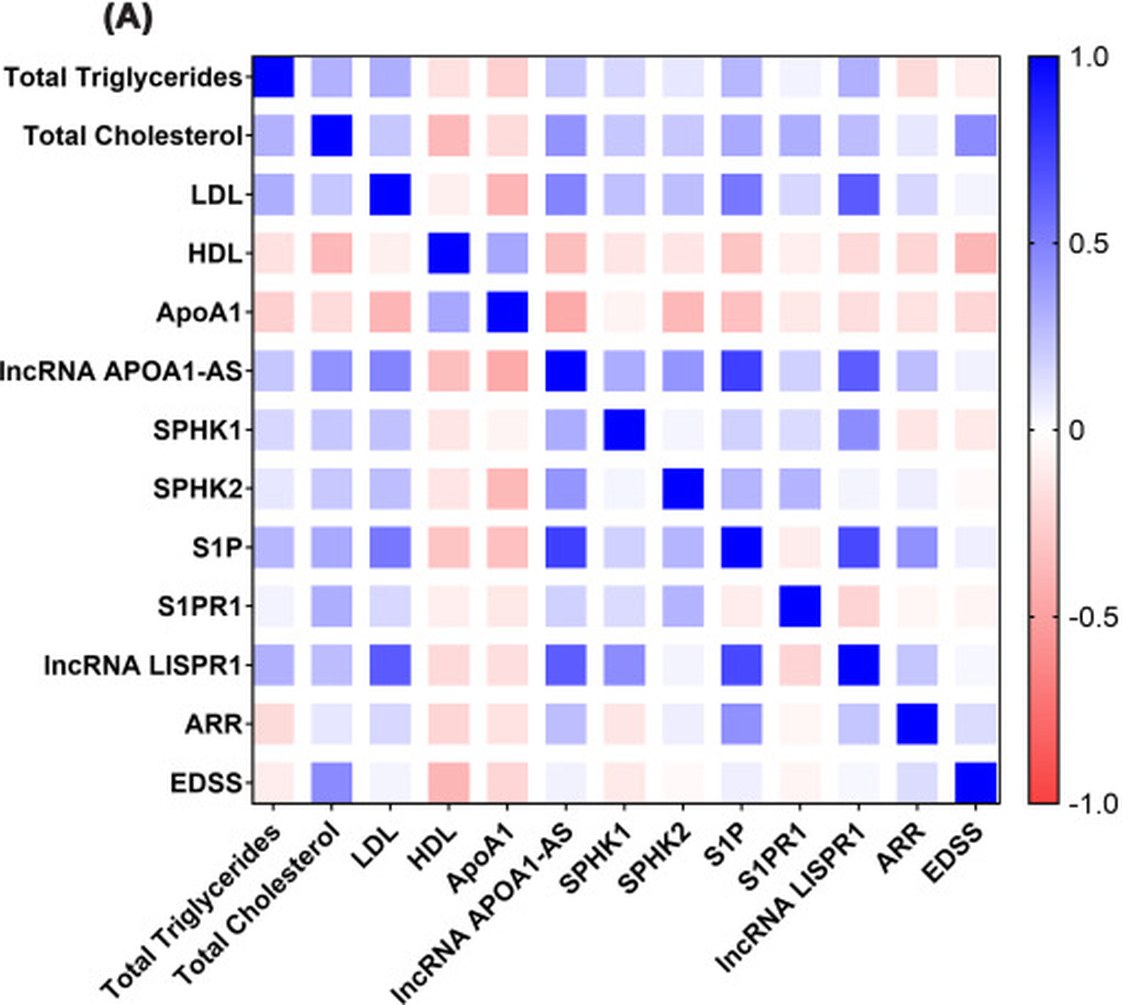
Correlations among the lipid fractions, the transcripts and the clinical measures in the 53 Cairo patients, where the two long non-coding RNAs sit closest to circulating sphingosine-1-phosphate and HDL cholesterol runs against disability. (Mehana, et. al. (2026), Bioscience Reports 46(6), BSR20260065, Figure 6A, CC BY 4.0)