

Three MS Readings Taken Years in Advance

Three studies of multiple sclerosis (MS) published this year share a structure that is easy to miss. Each takes a measurement years before the thing it is meant to inform. A combined genetic and environmental risk score is calculated in people who do not have MS and mostly never will. An apolipoprotein E genotype is read at a first clinic visit and held against twelve years of disability. One cholesterol ester is quantified in spinal fluid on the day of diagnosis and set against the following decade. In all three, what the early reading separates turns out to be narrower than what it was aimed at, and in all three the narrowing is reported in the same paper as the result.
Eighteen Diagnoses in Eight Thousand Person Years
Laitinen and colleagues report the current state of the Genes and Environment in Multiple Sclerosis project, a cohort of first-degree relatives recruited across the United States from 2011 onward. Of 2,686 people who consented, 1,903 completed the entry survey and form the analysed group, 80% women at a mean age of 33, close to the average age of MS onset, and seven surveys were collected over 11 years. At entry 141 participants (8%) already had MS. Over 8,526 person-years in the remaining 1,762, eighteen were diagnosed, a median of two years after entry at a median age of 37, and 1,744 were not. That gives an incidence of 211 per 100,000 relatives per year, with an interval from 113 to 308, roughly one in 500 annually and about a hundred times the rate reported for the general population. No imaging was collected, so radiologically isolated syndrome at entry could not be excluded.
Sixty-Four Variants, Then Two Hundred and Twenty-Four
Three scores were compared. The first weighted 64 replicated susceptibility variants, five of them in the major histocompatibility complex, by each published odds ratio; the combined score added three non-genetic factors, among them female sex and current smoking; an updated genetic score drew on 224 loci, 31 in the complex and 193 outside it, available for 111 of the 1,161 genotyped participants. The three ran together closely (ρ = 0.85, 0.81 and 0.80). The combined score was higher in participants who already had MS than in those who did not (median 11.69 against 11.14, p < 0.001), and it did not separate the eighteen converters from either group (p = 0.41 and p = 0.63). Asked to classify converters against non-converters, the scores gave areas under the curve of 0.57 and 0.56. The authors attribute this to eighteen events and write that the score would be improved by polygenic scores covering more of the genome.
An Allele Typed at the First Visit
Portaccio and colleagues took 160 consecutively referred patients with relapsing MS at the University of Florence, excluding anyone with a progressive course at the first evaluation or enrolled in a trial. DNA from blood was typed at rs7412 and rs429358 by high-resolution melting against sequenced reference samples, and the 27 patients (16.8%) carrying at least one APOE ε4 allele were compared with the other 133. The two groups matched at baseline on sex, age, disease duration and disability score. Over a mean follow-up of 12.3 years, 97 patients (60.6%) reached a first confirmed disability accrual, defined against a roving baseline and confirmed at 24 weeks. Accrual with no relapse within 90 days before or 30 days after both the onset and the confirmation accounted for 58 of those 97 events overall, for 51 of 79 events in non-carriers, and for 7 of 18 in carriers (p = 0.045).
Worsening That Followed the Relapses
Cox models adjusted for sex, age, disease duration, baseline disability, relapse count, the proportion of follow-up spent on disease-modifying therapy and visit density. Relapse-independent accrual went with male sex (HR 2.07), fewer relapses (0.88) and greater therapy exposure in the protective direction (0.20). Relapse-associated worsening went with the APOE ε4 allele at HR 3.33 (1.53 to 7.27, p = 0.002), and at 3.60 (1.62 to 8.02) in the 115 patients who relapsed during follow-up, where carriers also ended at a higher disability score (4.3 against 2.0, p = 0.010). Among the 45 patients with no relapse at all, the proportion of relapse-independent events was the same in carriers and non-carriers (33.3% against 38.9%, p = 0.758) and the allele did not enter the model. Carriers did not relapse more often. The authors list a single centre, 27 carriers, wide intervals, a baseline set at first visit rather than onset, and no imaging, and call the barrier-permeability reading of the result speculative.
One Cholesterol Ester Measured at Diagnosis
Torres and colleagues went to the metabolic step itself. Cholesterol released from damaged myelin has to be esterified, by lecithin cholesterol acyltransferase, before it can be stored in lipid droplets and returned to new membrane, and about 70% of the cholesterol in the adult brain sits in myelin. The group quantified one species, the 18:2 cholesterol ester, by targeted mass spectrometry in spinal fluid taken at diagnosis, before any steroid, from 115 treatment-naive patients in Lleida and 57 matched controls who had undergone lumbar puncture for suspected raised intracranial pressure, then followed the patients for at least ten years. The measurement did not separate patients from controls, nor relapsing from primary progressive disease, though it was higher in patients with oligoclonal bands. Against the ten-year outcome it did separate, running higher in the severe phenotype than the mild one, higher above a disability score of 4 than below it, and correlating with the disability score a decade later.
The Correlation That Depended on the First Drug
Within that outcome the lipid picked its part. It did not differ by relapse-independent progression or by relapse-associated worsening taken separately, and the widest gap was for the composite measure of disease activity at ten years. On its own the ester classified that endpoint at an area under the curve of 0.69, and combined with five clinical variables from around the time of diagnosis the model reached 0.92. Among the patients started on moderate-efficacy therapy the ester tracked the ten-year disability score (ρ = 0.3), while among the sixteen started on a high-efficacy drug it did not (ρ = −0.12), and the correlation returned when high-efficacy therapy arrived as a second or third option. The team notes the retrospective design, disability scored without timed walking or dexterity tests, and an assay that cannot tell free ester from the droplet-bound pool. In each study the reading came first and the outcome came years later, and in each it reached part of that outcome rather than all of it.
Disclaimer: This blog post is based on the cited studies and is intended for informational purposes only. It is not intended to provide medical advice. Please consult with a healthcare professional for any health concerns.
References:
Laitinen, A. W., Tozlu, C., Roostaei, T., et al., Xia, Z., & De Jager, P. L. (2026). A prospective study of individuals at risk of multiple sclerosis informs the design of primary prevention studies. Annals of Clinical and Translational Neurology, 13(8), 1591-1601. https://doi.org/10.1002/acn3.70340
Portaccio, E., Aprea, M. G., De Meo, E., et al., Nacmias, B., & Amato, M. P. (2026). Relapse-associated worsening in apolipoprotein E ε4 carriers with relapsing multiple sclerosis. Journal of Neurology, Neurosurgery and Psychiatry, 97(9), 774-779. https://doi.org/10.1136/jnnp-2025-338392
Torres, P., Sánchez, A. G., Sancho-Saldaña, A., et al., Brieva, L., & González-Mingot, C. (2026). 18:2 cholesterol ester is a novel prognostic biomarker of disease progression in multiple sclerosis. Molecular Neurobiology, 63(1), 698. https://doi.org/10.1007/s12035-026-05915-8
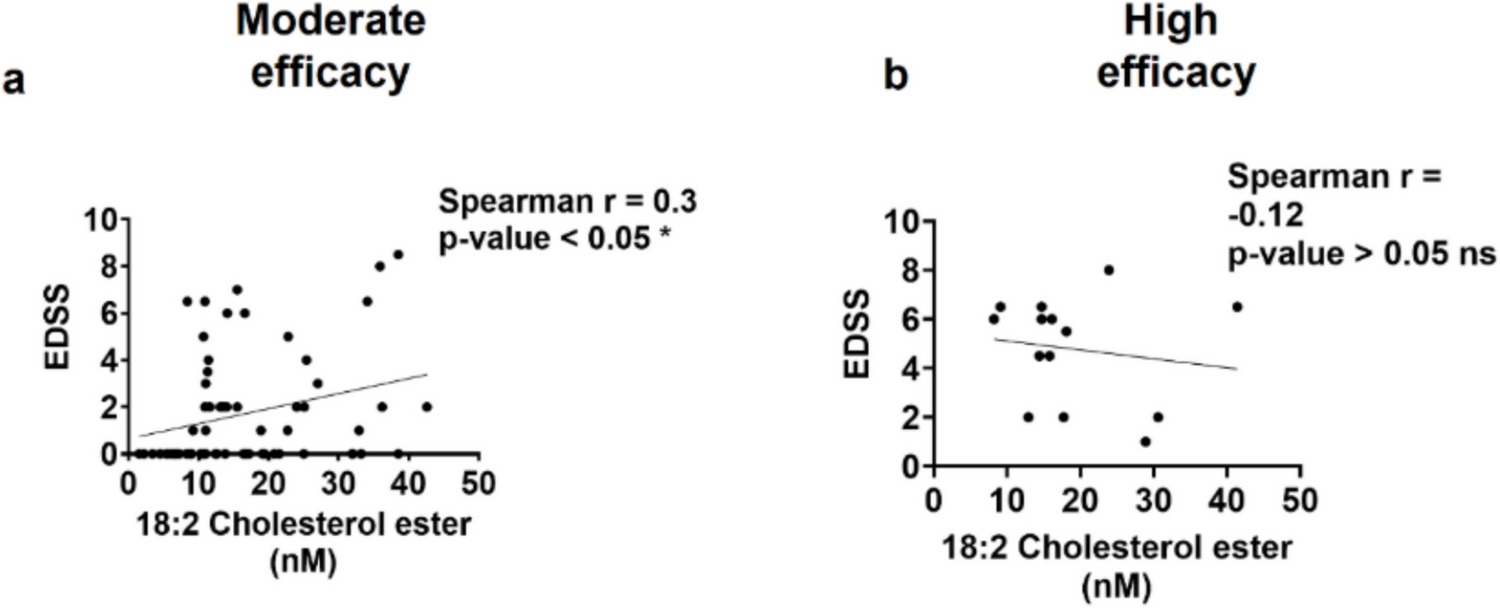
Disability score ten years on against the cholesterol ester concentration measured in spinal fluid at diagnosis, split by the efficacy class of the first treatment. The two panels hold the same measurement and differ in which drug followed it. (Torres, et. al. (2026), Molecular Neurobiology 63, 698, Figure 4, CC BY 4.0)