

Three MS Studies on a Gene, Plasma Lipids and Lifestyle

Three studies of multiple sclerosis (MS) published this year each measured two things in the same people, and in each the two readings point in different directions. One typed a single genetic variant and then followed both disability and MRI for eight years. One measured thirty-five lipid mediators in plasma and set them against disability, a blood marker of nerve damage, brain volume and lesion load. One ran a two-year lifestyle programme and reported both the group slopes and the number of participants whose own scores moved further than measurement error. In each the disagreement between the two readings is the result, and each team states which of its readings its design can support.
A Variant Typed in Ninety-Seven Patients
De Meo and colleagues genotyped rs6265 in the BDNF gene in patients followed at Careggi University Hospital in Florence. The variant substitutes methionine for valine at codon 66 and lowers activity-dependent secretion of brain-derived neurotrophic factor, a protein involved in synaptic plasticity, axonal maintenance and repair. DNA from blood leukocytes was typed by high-resolution melting and confirmed by Sanger sequencing. After quality control 97 relapsing-onset patients remained, 69 of them Val66Val and 28 carrying Val66Met, seen every six months and scanned annually at 3T for a mean of 8.1 years, giving 1,722 clinical visits and 998 scans. The two genotype groups matched at study entry on age, disease duration, disability, treatment, lesion volumes and brain volumes, with two exceptions: men were more common among carriers, and the cervical cord cross-sectional area at C2 was smaller in carriers, 56.2 against 62.4 square millimetres.
Fewer Events, Faster Atrophy
Sixty-eight disability worsening events occurred. Adjusted for age, sex, disease duration and treatment, Val66Met carriage went with a lower hazard of worsening overall, 0.51 (0.26 to 0.98), and the reduction sat in progression independent of relapse activity, 0.44 (0.20 to 0.94), and in progression independent of relapse and MRI activity, 0.38 (0.17 to 0.86). Relapse-associated worsening was not associated, 0.64 (0.22 to 1.91), and the relapse rate itself was the same in both groups. The imaging ran the other way. Carriers accrued new lesions faster, at a rate ratio of 1.18 (1.08 to 1.28), and lost normalised brain, white matter, deep grey matter and brainstem volume and cervical cord area faster than non-carriers. Adding lesion volume to the models left only the white matter difference standing. Myelin-sensitive intensity ratios and slowly expanding lesions did not differ by genotype, which the authors read as evidence against repair or smouldering inflammation carrying the clinical result.
Thirty-Five Lipids in One Birth Year
Fung and colleagues worked in Project Y, a Dutch cohort built by finding as many people as possible who were born in 1966 and later diagnosed with MS, examined in a single day at Amsterdam University Medical Center between December 2017 and January 2021. Because everyone shares a birth year, age is held fixed rather than adjusted away. Plasma was available for 285 patients, 169 of them relapsing-remitting, 80 secondary progressive and 36 primary progressive, and for 125 age-matched controls. Lipid mediators derived from omega-3 and omega-6 polyunsaturated fatty acids, the products of the pathways that both start and resolve inflammation, were measured by targeted liquid chromatography and tandem mass spectrometry. Mediators missing from more than a fifth of samples were dropped, leaving thirty-five. Men in the cohort had a higher disability score than women, 3.5 against 2.5, and more of them had a progressive course.
Where the Six Mediators Point
Among controls one mediator separated the sexes, 9-HOTrE, higher in women. Among patients six did: 9-HOTrE, 18-HEPE and 9-HODE higher in women, and 15-HEPE, 17-HDHA and 11,12-DiHET higher in men. Split by phenotype, no mediator separated men from women within relapsing disease, and one, 17-HDHA, did so within progressive disease. The six were then correlated with disability, serum neurofilament light, whole brain volume and lesion volume, adjusted for therapy, disease duration, phenotype and, for the blood marker, body mass index. The correlations were weak and they did not line up. In men, 9-HOTrE and 9-HODE went with lower disability and 11,12-DiHET with higher neurofilament; in women, four mediators went with lower brain volume. One of those, 9-HOTrE, went with lower disability and a smaller lesion load while also going with smaller brain volume, which the team reads as a mediator that may act on inflammation without protecting tissue. They call the findings exploratory and note that diet, comorbidity and hormones were not accounted for.
Six Hundred and Fifty-Nine People for Two Years
Gravesteijn and colleagues reported the two-year results of LIMS, a fully digital programme covering diet, physical activity, sleep and stress, delivered to people at home. Participants were recruited through the Dutch national MS foundation and two Amsterdam centres; 659 joined, mean age 46.2 years, 84% women, 71% relapsing-remitting, with a mean body mass index of 25.5 and a waist circumference in the high or very high risk band for about seven in ten. Diabetes, a body mass index outside 18.5 to 35, and current dietetic care were among the exclusions. The design ran in three phases: three months of run-in with no guidance at all, which served as each participant's own control period, three months of intensive intervention, and 21 months of maintenance with coaching sessions and webinars. Attendance was 95% at the introductory session and fell to roughly a quarter by the last maintenance sessions.
Group Slopes and Individual Change
During the intensive phase the physical impact score fell by 0.84 points a month and the psychological score by 1.09, body mass index by 0.25 units a month and waist circumference by 0.89 centimetres a month. Through the 21 months that followed, the physical score, body mass index and waist circumference all turned back upward, while the psychological score held flat. Dietary adherence improved and stayed above baseline; adherence to the national physical activity guideline never moved in any phase, with about a third of participants meeting it throughout. Between 3.8% and 6.4% of participants crossed the smallest change the questionnaires could reliably detect, against the 2.5% expected from random variation alone, and body mass index was the exception at roughly a fifth. Several scores had already improved during the run-in, before any advice was given. The team lists the absence of a control group, a self-enrolled and motivated sample, self-measured weight and waist, and attrition that may have kept the people doing well. In each of the three studies the second reading came from the same people as the first, and in each it answered a different question.
Disclaimer: This blog post is based on the cited studies and is intended for informational purposes only. It is not intended to provide medical advice. Please consult with a healthcare professional for any health concerns.
References:
De Meo, E., Addazio, I., Bonacchi, R., et al., Portaccio, E., & Amato, M. P. (2026). Brain derived neurotrophic factor Val66Met polymorphism modifies progression independent of relapse activity and structural damage trajectories in multiple sclerosis. Brain Communications, 8(6), fcag418. https://doi.org/10.1093/braincomms/fcag418
Fung, W. H., Chornyi, S., Schoonheim, M. M., et al., Strijbis, E. M. M., & Kooij, G. (2026). Sex-dependent bioactive lipid mediator profiles in multiple sclerosis. Multiple Sclerosis Journal - Experimental, Translational and Clinical, 12(3), 20552173261475501. https://doi.org/10.1177/20552173261475501
Gravesteijn, A. S., Nauta, I. M., Stob, M., et al., Uitdehaag, B. M. J., & de Jong, B. A. (2026). Sustained benefits of a multidomain lifestyle intervention in multiple sclerosis in the LIMS study: a 24-month follow-up. Neurology, 107(8), e218542. https://doi.org/10.1212/WNL.0000000000218542
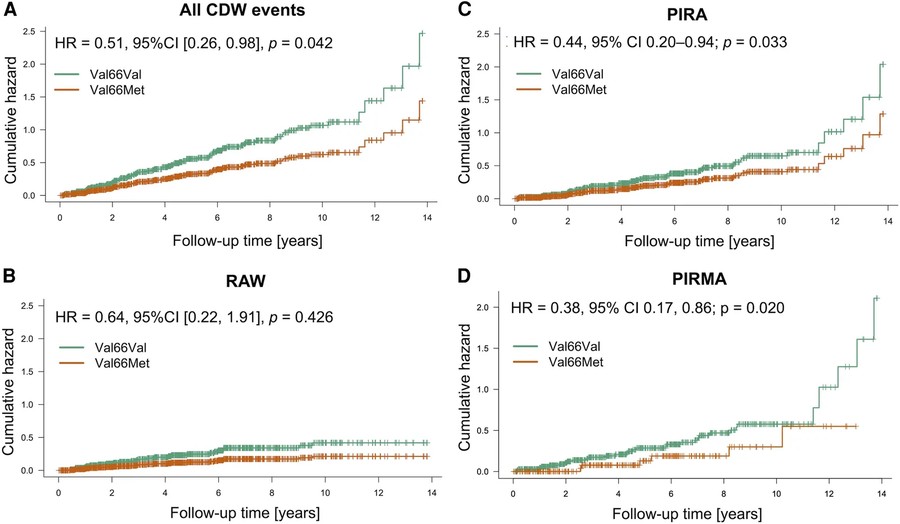
Cumulative hazard of disability worsening over follow-up by BDNF genotype, for all worsening events and for the three mechanisms separately. The curves separate for overall worsening and for both forms of relapse-independent progression, and not for relapse-associated worsening. (De Meo, et. al. (2026), Brain Communications 8(6), fcag418, Figure 1, CC BY 4.0)