

Three MS Studies on Smoking, Cholesterol and Risk Variants
Three studies of multiple sclerosis (MS) published this year each take a risk factor already established for the disease and ask how far it reaches. One asks whether the harm smoking does to disability depends on which class I HLA allele a patient carries. One takes a cholesterol ratio measured once at the start of a trial and asks what it says about the three years that follow, and whether treating it changes the answer. One takes the whole set of MS risk variants and asks whether they raise the risk of twelve common cancers. In each the factor reached part of what it was tested against and not the rest.
Smoking Measured Against Two HLA Alleles
Hedström and colleagues drew on two Swedish population-based studies: EIMS, which recruited incident cases through neurology units between 2005 and 2015, and GEMS, which identified prevalent cases from the national MS registry between 2009 and 2011. Genotypes were available for 6,807 of the 8,572 participants, with HLA alleles typed at two-field resolution on the MS replication chip. Of those included, 2,296 (34%) were smoking at diagnosis, 72.8% were women and the mean age at diagnosis was 37.8 years. Outcomes came from the registry: confirmed disability worsening, an increase sustained across two visits at least six months apart, and the time to reach disability scores of 3, 4 and 6 among those starting below 3. The two alleles of interest were carried by 42.3% (HLA-A*02:01) and 57.4% (HLA-DRB1*15:01) of the cohort, with the same distribution in smokers and non-smokers. Smokers were younger at diagnosis and started from a higher disability score, 3.0 against 2.6.
Where the Smoking Effect Sat
Among patients without HLA-A*02:01, each step up in smoking intensity carried a hazard ratio of 1.06 (1.02 to 1.11) for confirmed worsening, and each step up in cumulative smoking 1.08 (1.03 to 1.13). Among carriers the same two figures were 1.02 and 1.03. Taking non-smoking carriers as the reference, smokers without the allele reached disability score 3 at 1.26 (1.08 to 1.47) and score 4 at 1.50 (1.25 to 1.79), while smokers carrying it showed no raised risk at any milestone. For the score of 4 the attributable proportion due to interaction was 0.21 (0.01 to 0.42). The second allele gave a flat picture: smoking raised the risk whether or not HLA-DRB1*15:01 was present. The authors list self-reported smoking collected retrospectively in GEMS, genotypes for 79% of participants, and other alleles untested. They also note that association studies estimate the average effect of a variant, so one that acts only alongside an exposure can stay invisible.
One Cholesterol Ratio at the Start of a Trial
Williams and colleagues went back to MS-STAT2, a phase 3 trial that randomised 964 people with secondary progressive MS to 80 mg simvastatin or placebo. The cohort was advanced: median age 55 years, median disease duration 22.2 years, 73% women, and 72% already at a disability score of 6.0 or 6.5. Anyone already taking a statin was excluded. At screening every participant had a vascular risk assessment, with the lipid profile summarised as the cholesterol ratio, total cholesterol divided by high density lipoprotein, at a median of 3.4. Median body mass index was 25.3, median systolic pressure 127 mmHg, and 9.2% were current smokers. Disability was measured every six months for three years and cognition yearly, and a single-centre group of 246 participants was scanned yearly at 3T for lesion and brain volumes. The analyses were post hoc, and the team presents them as exploratory, with no correction for multiple comparisons.
Severity at Baseline, Lesions Afterwards
A higher cholesterol ratio went with worse disability at the start in every domain measured: an odds ratio of 1.195 (1.071 to 1.334) per unit on the disability score, slower walking and hand function, and lower memory scores. None of it carried forward. In the placebo group the ratio did not predict confirmed disability progression (0.952, 0.831 to 1.091), and randomisation to simvastatin changed no clinical relationship. In the imaging group it was unrelated to brain, grey matter and thalamic volume at the start and to their later loss. One outcome moved. In the placebo group each unit of baseline ratio went with a 2.47% larger increase in lesion volume from baseline to 24 and 36 months (0.03 to 4.97), and in the simvastatin group that increase was 3.10% smaller (0.06 to 6.06), a separation that appeared only after the first year. Body mass index tracked lesion growth in the same direction, and simvastatin did not change that relationship. The team lists the post hoc design, the loss of precision in three-way interaction models, and the exclusion of participants at higher vascular risk.
One Hundred and Forty-One Variants Against Twelve Cancers
Buyukkurt and colleagues took the question to the genome. They used 141 independent variants from an MS study of 47,429 cases and 68,374 controls, two of them in the HLA region and one tagging the allele with the strongest effect on MS risk. The outcomes were genome-wide studies of twelve common cancers, each covering 85,716 to 417,127 people of European ancestry, matching the MS data. A two-sample design regressed the variant-cancer associations on the variant-MS associations, scaled to a doubling in the odds of MS, with the HLA variants left out of the main analysis. Instrument strength averaged around 80 per cancer, and the twelve results were corrected for multiple testing. The team then looked inside windows of 250 kilobases around each lead variant, asking whether MS and a cancer were driven there by one shared variant or by two separate ones.
The Null and the Loci Underneath It
No cancer survived correction. The largest estimate was for cervical cancer, 1.01 (0.98 to 1.03) without the HLA variants and 1.03 (1.01 to 1.06) with them, and including them introduced pleiotropy traced to linkage between the variant tagging the main MS risk allele and a cervical cancer one. Underneath that null the window analysis returned twelve MS-cancer pairs across nine loci and six cancers: basal and squamous cell carcinoma, melanoma, breast and prostate cancer, and lymphoma. Ten of the twelve pointed in opposite directions, more often than chance would give (p = 0.019). The clearest sat at BACH2 on chromosome 6, shared with basal cell carcinoma at a posterior probability of 0.998 and with squamous cell carcinoma at 0.991, and fine-mapped to rs72928038, whose minor allele lowers BACH2 expression, raises the risk of MS and lowers the risk of both skin cancers. The authors list European ancestry only and the assumption of a single causal variant per locus. In each of the three studies the factor was carried past the question it was established on, and in each it reached one stratum, one outcome or one locus.
Disclaimer: This blog post is based on the cited studies and is intended for informational purposes only. It is not intended to provide medical advice. Please consult with a healthcare professional for any health concerns.
References:
Hedström, A. K., Stridh, P., Hillert, J., Olsson, T., & Alfredsson, L. (2026). Interaction between smoking and HLA-A*02:01 in multiple sclerosis progression. Multiple Sclerosis Journal, 32(9), 962-971. https://doi.org/10.1177/13524585261453243
Williams, T., Magill, N., John, N. A., et al., Ciccarelli, O., & Chataway, J. (2026). Investigating the treatment of vascular risk with simvastatin in secondary progressive multiple sclerosis: analysis from the MS-STAT2 randomized controlled trial. Brain Communications, 8(4), fcag240. https://doi.org/10.1093/braincomms/fcag240
Buyukkurt, A., Ygonia, M., Manouchehrinia, A., Lefrançois, P., Kockum, I., & Harroud, A. (2026). Shared genetic effects and antagonistic pleiotropy between multiple sclerosis and common cancers. Annals of Clinical and Translational Neurology, 13(6), 1249-1257. https://doi.org/10.1002/acn3.70298
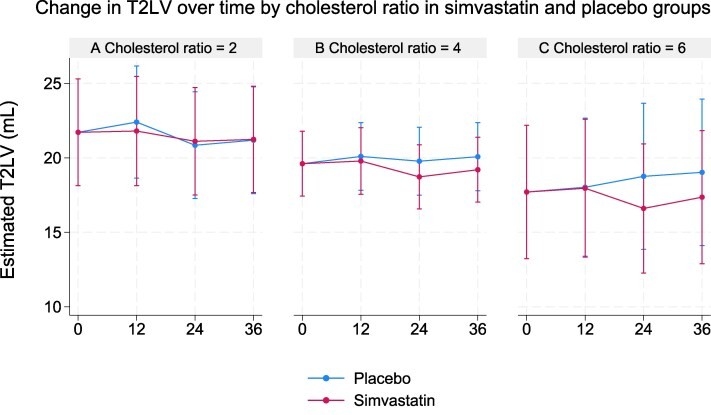
Estimated lesion volume over three years in the placebo and simvastatin groups, modelled at three values of the cholesterol ratio measured before treatment. The two groups stay together at a ratio of two and separate after the first year at a ratio of six. (Williams, et. al. (2026), Brain Communications 8(4), fcag240, Figure 1, CC BY 4.0)