

The Conditions an MS Risk Variant Needs
Multiple sclerosis (MS) genome-wide association studies have delivered more than two hundred susceptibility loci, nearly all of them non-coding and nearly all of them immune. The distance between that list and a mechanism stays wide, and one reason is that the effect of a risk allele is usually conditional. It needs the right stimulus, the right tissue compartment or the right cellular resolution before it registers at all, and a measurement taken without that condition returns nothing. Three 2026 studies each supply one of those conditions. One follows a coding variant that looks inert until vitamin D is added. One moves the measurement from blood to cerebrospinal fluid. One rebuilds transcriptome-wide association testing at brain cell subclass resolution and counts the difference.
A Risk Allele That Looks Inert
Kari and colleagues worked on rs763361, a non-synonymous variant in CD226 that swaps glycine for serine at position 307 and raises MS risk. CD226 sits on CD4+ T cells and is strongly induced by CD46 costimulation, the route that switches human T cells from a Th1 programme to type I regulatory (Tr1) cells with high IL-10. Deleting CD226 by CRISPR/Cas9 in primary CD4+ T cells cut IL-10 production by around 40% while leaving CD46 shedding, CD69 induction and Tr1 frequency alone, so the gene belongs to the pathway. They then compared healthy donors homozygous for the risk (T/T) and non-risk (C/C) genotypes under the same stimulation. CD69, CD25, PD-1 and CD46 levels matched. Tr1 frequency matched. Cytokine production differed only as a trend toward more IFN-γ-producing cells, at P = 0.0525.
The Stimulus the Variant Needs
Vitamin D deficiency is an established MS risk factor, and active vitamin D pushes CD46-activated T cells toward IL-10. Adding it split the genotypes apart. In C/C donors the IFN-γ-negative IL-10-positive fraction rose; in T/T donors it did not, and c-MAF and Blimp-1, two transcription factors tied to IL-10, came out lower. Vitamin D sensing itself was intact, with equal VDR expression, nuclear translocation and induction of the target gene CYP24A1 in both genotypes. The difference sat at the integrin LFA-1. Vitamin D sharply raised LFA-1 conformational activation in C/C cells, read with the high-affinity m24 antibody, and failed to do so in T/T cells carrying the same amount of CD11a. Blocking that activation with BIRT377 reduced Tr1 development and IL-10, and breaking up T cell clusters twice a day lowered the IL-10 to IFN-γ ratio.
The Same Allele, Read in Patients
In CD4+ T cells from people with relapsing-remitting MS, the genotype gap absent in healthy donors turned up: T/T carriers had lower activation and fewer Tr1 cells than C/C carriers, and vitamin D again raised LFA-1 activation in C/C but not T/T. The authors then stratified the SOLARIUM supplementation trial by CD226 genotype wherever genetic material remained. In the placebo arm, MRI activity ran independent of genotype. In the supplemented arm, the five people homozygous for the non-risk allele and the eleven heterozygotes had no MRI activity, and the only two with MRI activity were T/T homozygotes. Eighteen genotyped patients is a small set, and the authors present it as proof of concept supporting a hypothesis rather than as evidence: that the benefit of vitamin D supplementation may depend in part on this genotype.
Changing the Compartment
Han and colleagues asked where MS-associated methylation is visible and chose cerebrospinal fluid cells over blood. Post-bisulfite adaptor tagging whole-genome sequencing on cells from five people with relapsing-remitting MS and five non-inflammatory controls covered about 28 million CpG sites, of which 11.7 million passed the coverage threshold. Three statistical methods converged on 2,710 differentially methylated positions and 4,330 regions, median difference 21%, maximum 89%. Technical replicates reproduced 91.7% of testable positions, and an independent cohort of thirty donors reproduced 74.8% of those changing by at least 5%. Deconvolution found comparable immune cell composition in both groups, so the signal is not a shift in which cells were sampled. Differentially methylated regions were enriched within 2 kb of International MS Genetics Consortium lead variants (permutation P = 0.033), with 70 of 560 candidate MS risk genes overlapping one.
Which T Cell States Carry the Marks
Direction followed function. Genes tied to pro-inflammatory Th1 and Th17 activity, including TBX21 and CXCR5, tended to be hypomethylated in MS, while IL2RB and other regulatory genes were more often hypermethylated, and one region overlaps a polygenic-risk-score MS variant near CD37. Mapped onto chromatin states from 229 T cell samples, naive CD4+ signal fell at active transcription start sites and memory CD4+ signal at enhancers, with regulatory T cells and Th17 cells on different enhancer states again. The largest aggregation fell on the protocadherin loci: 6 positions and 27 regions across 43 PCDH genes, nearly all hypermethylated, alongside modest drops in expression. The PCDHG cluster is expressed in sorted T cell subsets, protein was detectable in 3 to 4% of live T cells, and pan-PCDHγ-positive frequency was lower in MS donors among CD45RO-negative CD4+ T cells (P = 0.05). The profiling was on bulk CSF, so the authors leave subset attribution to single-cell methylomes.
Counting at the Right Resolution
Venkatesh and colleagues rebuilt the reference side of transcriptome-wide association testing. From the PsychAD single-nucleus atlas, over six million nuclei from 1,494 donors of European, African and admixed American ancestry, they trained 94 imputation models across 32 cellular populations of the dorsolateral prefrontal cortex and ran them against twelve brain disorder GWAS, MS among them. Resolution changed the count. For MS, homogenate cortex returned 145 significant gene-trait associations and pooled nuclei 130, while cell classes returned 276 and subclasses 317. Across all traits, 22.5% of significant associations, 3,711 of 16,345, were missed by both bulk TWAS and MAGMA. Enrichment for genes with known central nervous system phenotypes reached 5 of 12 traits at homogenate level and all 12 at subclass level. Fine-mapping for MS gave 230 genes across 149 loci at subclass resolution, against 61 across 58 from pooled nuclei.
What the Three Share
The three studies use different material and arrive at the same shape. A signal shows up when the measurement carries the condition it depends on: vitamin D for a coding variant in CD226, cerebrospinal fluid rather than blood for methylation at MS risk loci, cell subclasses rather than homogenate for imputed expression in cortex. Each also names where it stops. The SOLARIUM arm rests on eighteen genotyped patients. The CSF methylomes are bulk, so the protocadherin marks cannot yet be assigned to a T cell subset. The imputation models cover one brain region. What none of them does is stack the conditions in one study: a cohort genotyped at a conditional locus, sampled where the relevant cells sit, and read at a resolution fine enough to name which cell changed.
Disclaimer: This blog post is based on the cited studies and is intended for informational purposes only. It is not intended to provide medical advice. Please consult with a healthcare professional for any health concerns.
References:
Kari, S., Debonlier, A., et al., Dupré, L., & Astier, A. L. (2026). Multiple sclerosis-associated CD226 variant disrupts vitamin D-induced type I Treg differentiation by impairing LFA-1 activation. The Journal of Clinical Investigation, 136(20), e202193. https://doi.org/10.1172/JCI202193
Han, Y., Zheleznyakova, G. Y., et al., Needhamsen, M., & Jagodic, M. (2026). DNA methylation landscape of cerebrospinal fluid cells in multiple sclerosis: an epigenome-wide association study. EBioMedicine, 131, 106454. https://doi.org/10.1016/j.ebiom.2026.106454
Venkatesh, S., Kosoy, R., et al., Voloudakis, G., & Roussos, P. (2026). Single-nucleus transcriptome-wide association study of human brain disorders. Nature, 657(8133), 1016-1026. https://doi.org/10.1038/s41586-026-10836-6
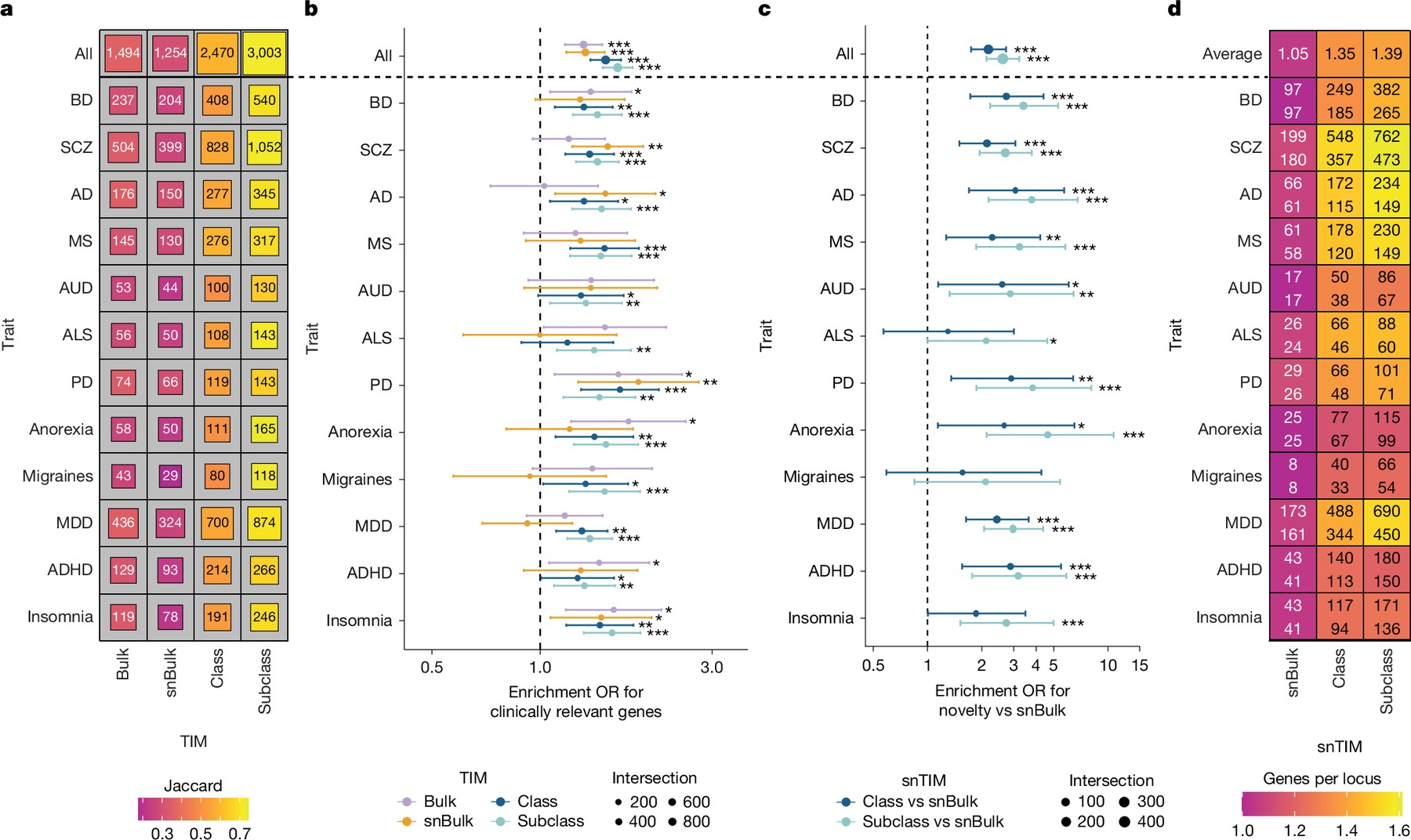
What resolution buys. For the MS row, homogenate cortex and pooled nuclei return 145 and 130 gene-trait associations, cell classes 276 and subclasses 317, with the novelty and fine-mapping gains shown alongside. (Venkatesh, et. al. (2026), Nature 657(8133), 1016-1026, Figure 2, CC BY 4.0)